

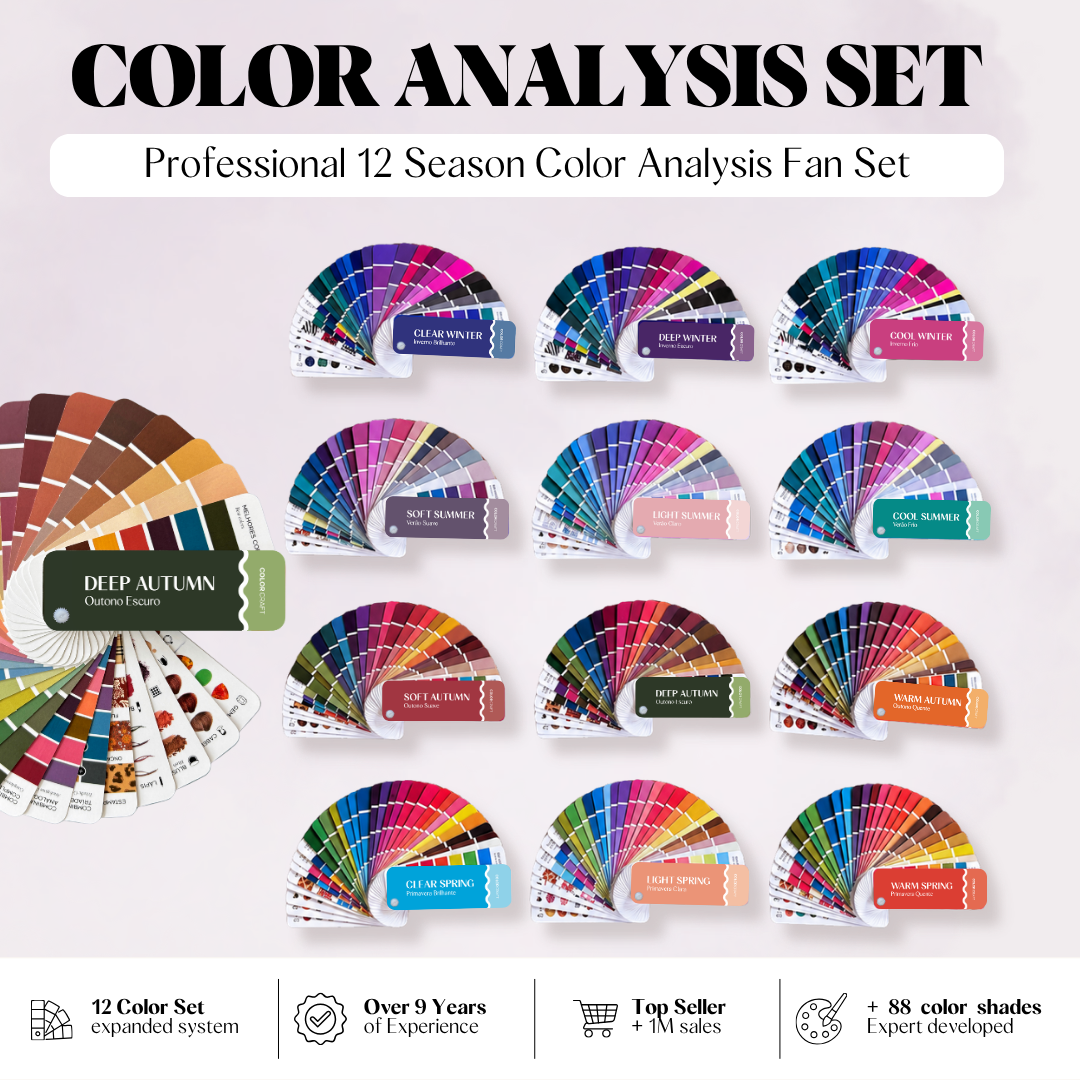
Quick answer: Yes — every color exists in every one of the twelve seasonal palettes. Personal color analysis doesn't ban colors; it identifies the specific tone, depth, and intensity of a color that works best with your natural coloring. The doctrine at the heart of the method is that a color palette should never feel like a prison.
This is probably the single most misunderstood idea in personal color analysis — and it's worth clearing up properly.
Where the myth comes from
Early, simplified versions of seasonal color theory sometimes presented palettes as fixed lists of "allowed" colors, which made it sound like entire colors — black, orange, neon green — were simply off-limits for certain people. That framing stuck, even though it was never accurate to how the method actually works.
What's actually true
Every seasonal palette contains its own version of every hue. There's a green for a Deep Winter and a completely different green for a Soft Autumn — same color family, different tone, depth, and intensity. Nothing on the color wheel is exclusive to one palette or banned from another.
What actually changes between palettes
What shifts is the exact shade: how warm or cool it leans, how light or dark it sits, and how saturated or muted it is. A Bright Winter's red is clear and blue-based; a Warm Autumn's red leans brick and golden. Both are "red" — they're just different reds.
Why this matters practically
Once you stop thinking in terms of banned colors, shopping gets easier, not harder. Instead of avoiding a color you love, you go looking for your specific version of it — the right depth and undertone — rather than giving it up entirely.
Color Craft's training courses teach the full twelve-palette method, including how to find each person's specific version of any color.
FAQ
Are there any colors that are genuinely hard for certain palettes?
Some specific shades will always be more flattering than others for a given palette — but that's a matter of degree, not an outright ban on the color family.
Does this apply to makeup and hair color too?
Yes — the same principle holds. A red lipstick exists for every palette; the exact shade of red is what changes.
Why do some consultants still talk about "forbidden" colors?
It's usually shorthand or a simplification for beginners — not because the underlying method actually restricts colors that way.
A color palette should never feel like a prison — it's a shortcut to finding your best version of any color, not a list of what to give up.
